Social Theories of Learning
Social theories of learning believe that learning is always undertaken in a social and cultural context. Social theories of learning rely on communication and language, and are about having interactions with others through group work, discussions, problem-posing and problem-solving. The key idea is that tamariki learn through interactions with others, observation, communication, collaboration and supported learning.

How does Social Learning Theory inform the teaching of Maths and Science in the Early Years?
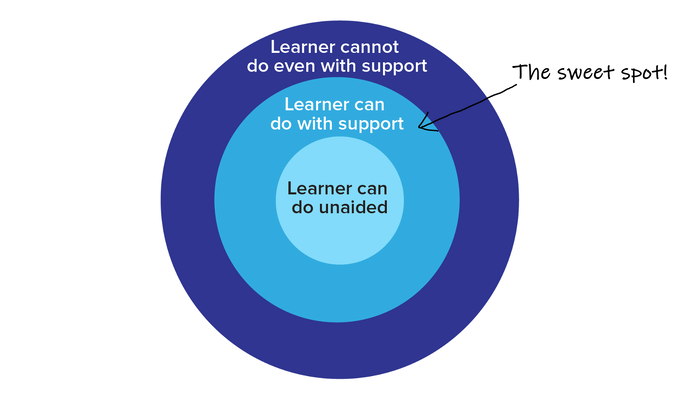
Children need to feel safe and supported when learning; they thrive on being comfortable within their environment. A way to achieve this is by using the Zone of Proximal Development (or ZPD). It is a concept developed by psychologist Lev Vygotsky as part of his theory of child development and learning.
The ZPD refers to the gap between
- What a learner can do independently - tasks they can complete without help.
- What a learner can do with guidance - tasks they cannot yet complete alone but can achieve with support from an adult.
Learning needs to be appropriately challenging:
- If learning is too easy, children may not make progress and may lose motivation.
- If learning is too difficult, children may miss important learning opportunities.
- Tailor learning to children's developmental stages and individual needs.
Learning should be:
- Scaffolded sequentially.
- Connected to previous learning and experiences.
- Built upon gradually, like climbing a staircase.
- Appropriate to each child's individual needs.

Peer Learning and group work
Peer learning
- Allows tamariki to develop communication skills.
- Encourages explanations and representations.
- Helps students explore ideas more deeply.
Group work
- Allows kaiako to provide targeted teaching.
- Supports groups of students who need particular lessons.
- Encourages collaboration and shared understanding.
How do tamariki learn from each other?
- Use mixed-ability groupings.
- Encourage tamariki to ask each other questions.
- Create activities where communication and collaboration are expected.
- Encourage mathematical conversations.
- Allow students to explain their thinking to their peers.
An important point: A silent classroom does not necessarily mean learning is happening. Noise can represent communication, mathematical language, and thinking.

Number bonds to 20
Learning intention: For students to learn number bonds to 20.
Teaching sequence:
- Counters - Tamariki were given 20 counters, then randomly split the counters into two groups and recorded the numbers in each group.
- Visual Representation - Students created rainbow representations of each number bond and identified the patterns.
- Numicon - Students matched two Numicon numbers together to make 20.
- Equations - Students recorded their number bonds as equations in their books.
- Ongoing recall - Warm-ups were used to practise and consolidate number bonds to 20.
How tamariki worked together:
- Students worked in pairs.
- They took turns completing the activity.
- They discussed the patterns they noticed.
- They shared their mathematical thinking.
How this demonstrates Social Learning Theory:
Through multiple approaches and recurring lessons to facilitate understanding and consolidation, students developed their understanding through interaction, communication, and shared experiences.
Create Your Own Website With Webador